Most expats arrive in the Netherlands assuming they will live in Amsterdam, and many do. But Amsterdam is not the only — or always the best — choice. The Netherlands is small enough that any of its major cities is a viable expat home, and several offer a meaningfully better balance of cost, housing availability, and quality of life. Below, an honest comparison of the five most relevant cities for international professionals in 2026.

Amsterdam
Amsterdam is the obvious starting point and remains the most international-friendly city in the country. English is spoken almost universally in shops, restaurants, and offices, particularly in the centre and the wealthier neighbourhoods. The expat community is large and easy to plug into. Cultural infrastructure — museums, restaurants, music venues, festivals — is unmatched in the Netherlands and competitive with any European capital.
The drawbacks are housing cost and availability. One-bedroom apartments in central neighbourhoods rent for €1,800–€2,400 per month. Properties for sale start around €450,000 for a small studio and quickly exceed €700,000 for anything family-suitable. Housing supply is constrained by physical geography (canals, listed buildings) and policy (short-stay rentals are tightly restricted, social housing absorbs a substantial portion of the stock). Most expats end up in Amsterdam-Noord (across the IJ), Diemen (just east of the city), or Amstelveen (south, where many international families live).
Rotterdam
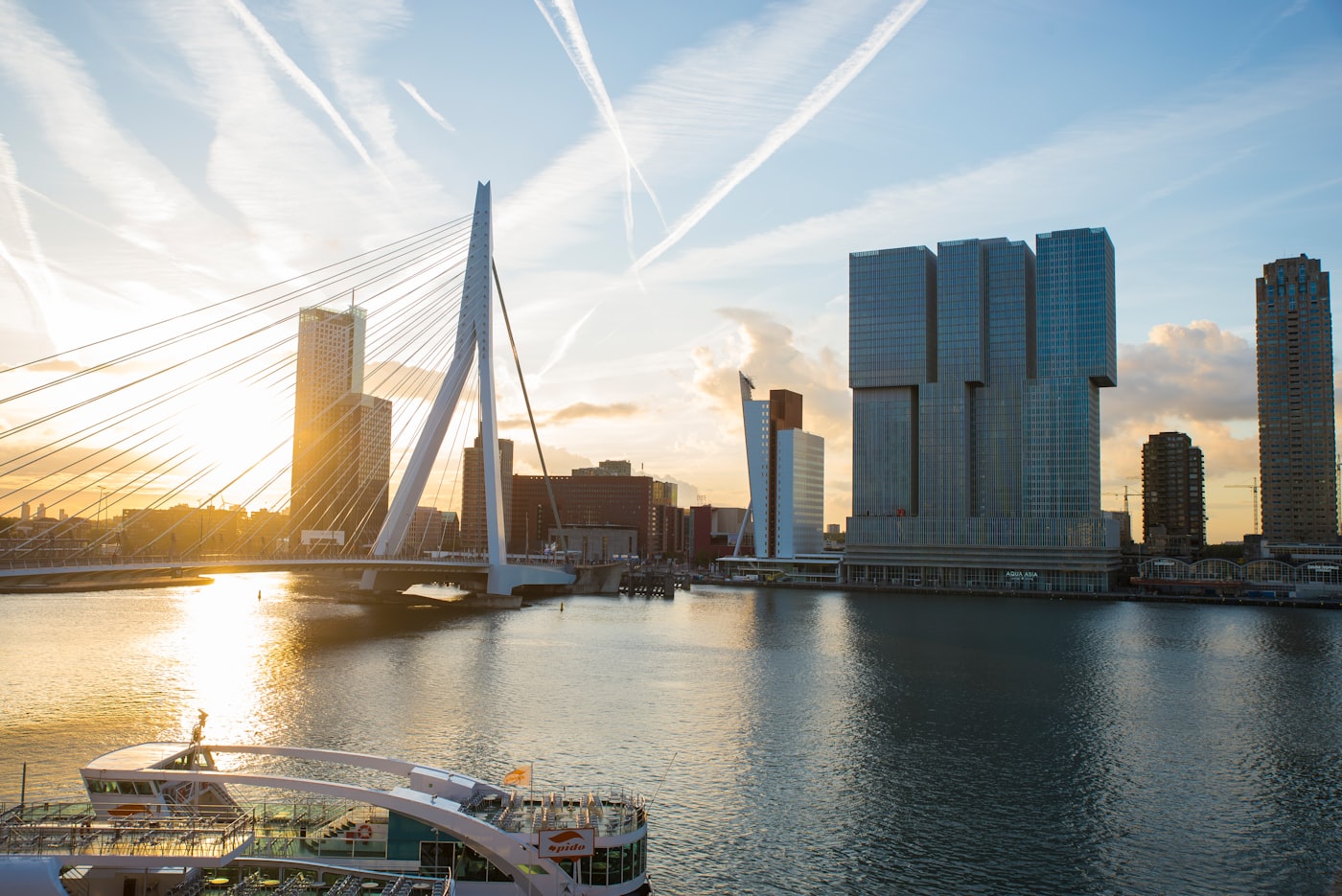
Rotterdam is the country's second city and has been the most overlooked expat destination for years. Rents are 30–40 per cent below Amsterdam for comparable apartments. The city was destroyed in 1940 and rebuilt with modern architecture, giving it a markedly different feel from the rest of the Netherlands — high-rise buildings, broad streets, a working port-and-finance centre. English is widely spoken in business and in the centre, though slightly less universal than in Amsterdam.
The expat scene in Rotterdam is real but smaller than Amsterdam's; if your job is here (Unilever, Shell, the port, the Erasmus University and medical centre), Rotterdam is the rational choice. If your job is in Amsterdam but you live in Rotterdam, the train commute is about 40 minutes door-to-door, which is workable but adds up.
The Hague (Den Haag)
The Hague is the seat of the Dutch government and the legal capital — the International Court of Justice, the International Criminal Court, Europol, Eurojust, and many international NGOs are based here. This gives it a uniquely international population: roughly 25 per cent of residents are expats or international civil servants. English is everywhere. The international school infrastructure is exceptional, making The Hague the best Dutch city for expat families with school-aged children.
Housing costs sit between Amsterdam and Rotterdam — €1,300–€1,800 for a central one-bedroom. Beach access (Scheveningen and Kijkduin) is fifteen minutes by tram. The city is calmer and more residential than Amsterdam or Rotterdam, which expats either love or find boring depending on their stage of life.
Utrecht
Utrecht is the most central city geographically and is increasingly the most expensive after Amsterdam. The medieval centre is beautiful, the city is compact and walkable, and the train station is the busiest in the country — you can be in Amsterdam, Rotterdam, The Hague, or Eindhoven within an hour. The university and several major hospitals are significant employers; ASR, Rabobank's headquarters, and a growing tech scene round out the economy.
The expat community is moderate-sized — large enough to find international groups, schools, and English-speaking services, but smaller and less institutionalised than Amsterdam or The Hague. Housing costs €1,400–€1,900 for one-bedroom central. Many expats working in Amsterdam choose Utrecht as a base for the better housing value and faster commute than the outer Amsterdam suburbs.
Eindhoven
Eindhoven is the centre of the Brainport region in the south and home to ASML, Philips, NXP, Signify, and a dense ecosystem of high-tech firms. If you work in semiconductors, photonics, or industrial automation, your job is here regardless of where you might prefer to live. The expat community is large and overwhelmingly engineering-focused — roughly 40,000 international knowledge workers live in the Brainport region.
Eindhoven is the cheapest of the cities listed here for housing: one-bedroom rentals run €1,000–€1,500, and property purchase prices are 30–40 per cent below Amsterdam. The city itself is more functional than charming — rebuilt after wartime bombing, dominated by Philips' industrial legacy — though the Strijp-S area and the city centre have been substantially revitalised over the past decade. International schools are strong (notably ISE — the International School Eindhoven). Most expats find Eindhoven extremely practical for raising a family and somewhat dull for single life.
Honourable mentions
Haarlem, just west of Amsterdam, offers village-feel living with a 20-minute train commute into the capital and roughly 20 per cent cheaper housing. Delft, between The Hague and Rotterdam, is a small university city with a charming centre and a growing international tech presence. Groningen, in the north, has a strong student town atmosphere and substantially lower costs but is two hours by train from the Randstad — less practical if your job is in the main commercial centres.
How to choose
Choose based on where your job is first, where you would want your children to be in school second, and where you find the lifestyle that suits you third. For single professionals in their twenties and thirties, Amsterdam usually wins despite the cost. For families, The Hague is unmatched. For technical professionals, Eindhoven. For maximum value for money in a real city, Rotterdam. For most everything in moderation, Utrecht.
The commute changes the calculation
The Netherlands is small and densely connected, which means the city you work in and the city you live in need not match — and for many expats, decoupling them is the single most effective financial decision available.
Rotterdam to Amsterdam, Utrecht to Amsterdam, and Leiden or Haarlem to either are all routine intercity commutes. Rent differences of several hundred euros a month between these cities frequently exceed the annual cost of the train ticket, and our cost of living guide sets out the gaps.
Two cautions. Dutch rail fares are distance-based and a daily intercity commute is not a trivial cost, so price the actual journey rather than assuming. And check whether your employer contributes to travel costs, which many do — it can change the arithmetic entirely.
If you have children: schooling drives the decision
For families, school access usually outranks rent, and it is worth deciding in that order rather than finding housing first.
International schools cluster around Amsterdam, The Hague, Rotterdam and Eindhoven, and The Hague in particular has unusual depth because of the diplomatic and international-institution population. Places are limited, waiting lists real, and fees at private international schools substantial — though Dutch international schools with public funding are considerably cheaper where you qualify.
Dutch state schooling is high quality and free, and younger children generally absorb the language quickly. Older children arriving mid-education are the harder case, and it is the age at which international schooling stops being a preference and starts being close to a necessity. Decide the school first; the neighbourhood follows from it.
The cities people move to second
A pattern worth knowing: many expats arrive in Amsterdam, stay two or three years, and then leave — not for another country, but for another Dutch city. The trigger is usually housing costs, a growing family, or simply exhaustion with the rental market.
Haarlem, Leiden, Delft, Utrecht and Amersfoort absorb much of that movement — smaller, calmer, meaningfully cheaper, and still well connected. If you already suspect Amsterdam is not a long-term fit, it is worth looking at these earlier rather than after two years of paying Amsterdam rent.